


If your basement ceiling grazes the top of your head, or your foundation walls are starting to show cracks, you’ve probably already thought about WillFix basement underpinning services in Toronto. The real question isn’t whether to do it. It’s when. And right now, Summer 2026 is shaping up to be the best time to get this done.
Timing matters more than most people realize with basement underpinning. Let’s break down how the upcoming season is expected to be the best time to act, what signs tell you it’s already long overdue, and what to expect from the process.
Why Summer 2026 Is the Best Time for Basement Underpinning
Timing an underpinning project isn’t random. The season you choose affects everything from cure times, soil conditions, permit processing, and even contractor availability.
The Ground Works With You, Not Against You
Toronto winters are brutal on excavation work. Frozen soil is harder to dig, slower to stabilize, and far more unpredictable when it thaws. Summers give crews dry, workable ground, which is the kind that makes precise excavation possible and keeps the project moving on schedule. Concrete poured in warmer temperatures also sets faster and more evenly, which directly affects the structural integrity of your new foundation.
Permit Processing Tends to Move Faster
Toronto basement underpinning requires a permit under the Ontario Building Code, and summer queues tend to be shorter than the spring rush. Getting your application in early gives you a real scheduling advantage. For a full breakdown of requirements, timelines, and costs, see our Toronto basement underpinning permits guide.
You’ve Got Time to Plan the Full Scope
Underpinning project is rarely a standalone job. Most homeowners pair it with waterproofing, drainage upgrades, or a full basement renovation. Summer 2026 gives you enough lead time right now to plan the complete scope, get multiple quotes, and line up your basement underpinning financing options without feeling rushed. That planning window matters more than most people realize.
Renovation Season Momentum
Finishing a basement after underpinning, including new flooring, framing, and electrical, is far easier when you’re not fighting cold, damp conditions. Summer completions mean your contractor can hand off a dry, stable space to finishing crews immediately. No delays waiting for moisture levels to drop. No heaters running to keep concrete workable.
Signs Your Basement Actually Needs Underpinning
Don’t start planning Summer 2026 timelines before confirming this is the right fix for your specific situation. Basement underpinning addresses foundation depth and structural integrity, and not every crack or damp wall calls for it. But these signs usually do:
Cracks That Keep Coming Back

Hairline cracks are common. However, some cracks deserve a closer look, especially if they’re forming around windows, stretching across walls, or growing larger week by week. They suggest the foundation is shifting or settling unevenly, which is exactly what underpinning is designed to correct.
Doors and Windows That Won’t Cooperate
If interior doors are no longer closing properly and the issue has worsened over time, it may be a sign of a larger problem. Foundation movement distorts door frames and window openings. It’s subtle at first, then suddenly it isn’t.
Ceiling Height Under 6 Feet
A basement ceiling at 5’8″ isn’t livable space in any practical sense. Many Toronto homeowners choose basement lowering to create a taller basement that can be used as a bedroom, home office, gym, or rental suite. Underpinning work is the structural process that makes this possible.
Uneven or Sinking Floors
Floors that slope toward one wall, or feel soft in certain spots, often trace back to foundation settlement. In many Toronto homes built between the 1930s and 1960s, footings were not installed deep enough, allowing the soil beneath them to slowly compress over time.
Visible Bowing in Foundation Walls
This one doesn’t wait. Bowing or bulging foundation walls mean lateral soil pressure is winning. Basement underpinning reinforces and deepens the footing system, giving the walls proper support before the damage spreads upward into the structure.
What Underpinning Project Actually Involves
People hear “underpinning” and picture a complicated, months-long ordeal. The reality is more structured than that.
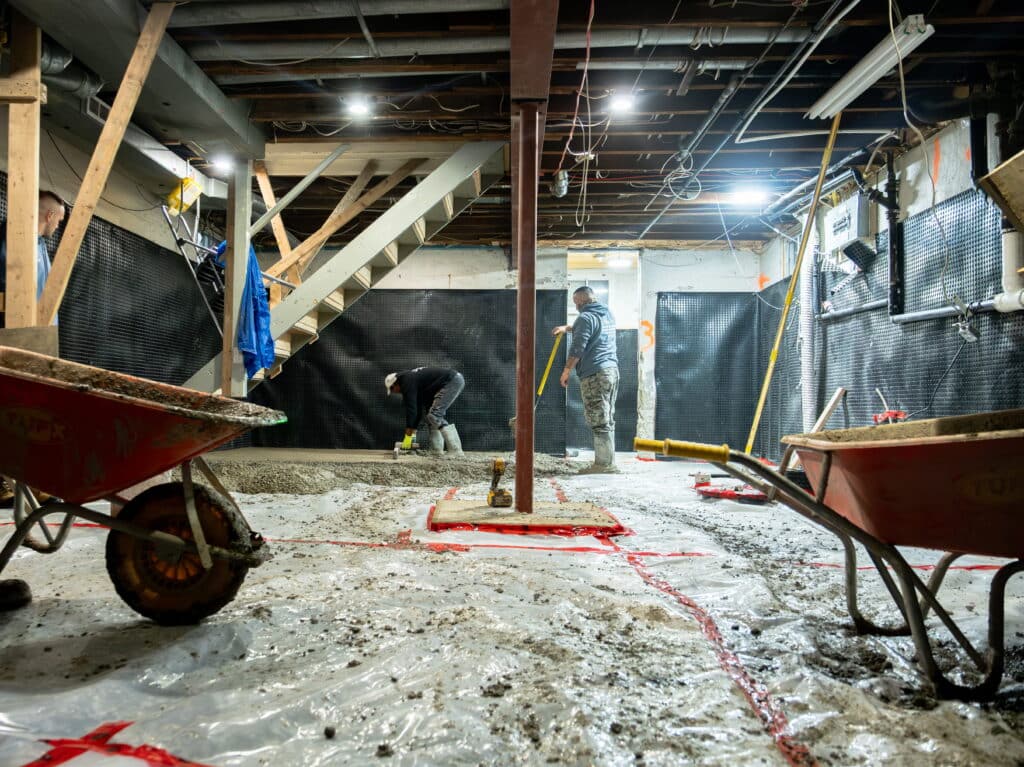
The process works in parts. Our crew excavates beneath your existing footings in small, carefully sequenced intervals: never the full length of the wall at once. Each section gets new concrete poured and cured before the adjacent section is touched. This phased approach keeps your foundation stable throughout the project.
A standard underpinning project in Toronto typically runs six to twelve weeks from permit approval to completion, depending on the home’s size, the depth being added, and whether waterproofing or drainage work is included in the scope. Homes built on clay-heavy soil, which covers a significant portion of Toronto, sometimes require additional stabilization measures.
Costs vary considerably. Depth, foundation perimeter, soil conditions, and finishing scope all factor in. Use our basement underpinning cost calculator to get a realistic starting estimate before you call anyone.
Pairing Underpinning With Waterproofing: A Summer Advantage
Once your foundation is exposed during the underpinning process, it’s the single best opportunity to waterproof properly. Exterior waterproofing, which includes membrane application, drainage board installation, and weeping tile, requires access to the outside face of your foundation walls. That access exists naturally during underpinning excavation.
Doing both together as one big project is almost always cheaper than scheduling them as two separate tasks, making this summer the best time to undergo this process. You’re paying for one mobilization, one permit, one excavation and backfill cycle. The marginal cost of adding waterproofing during underpinning is a fraction of what it costs to re-excavate later.
Summer conditions also accelerate membrane curing and reduce the risk of water infiltration during the open excavation phase, which is a genuine concern during spring thaw or fall rainy seasons.
How to Get Ready Before Summer 2026
Getting ahead of this project means more than calling a contractor in June. Here’s what the prep actually looks like:
- Get a structural assessment now. A qualified engineer’s report confirms whether foundation underpinning is the right solution and what depth is appropriate for your property.
- Pull your permit early. Toronto building permits for underpinning can take four to eight weeks to process. Apply before the summer rush, not during it.
- Sort your financing. Some financing arrangements take two to four weeks to finalize, so planning ahead can help keep your project on schedule.
- Get three quotes. Not one. Not two. But three from contractors who’ve done underpinning projects in Toronto specifically, and who can show permits and references.
- Plan the finish. If you’re converting the space after underpinning, get a finishing contractor lined up before the structural work finishes. The best ones book up fast in summer.
None of these steps is complicated on its own. The challenge is doing them in the right order, early enough that you’re not scrambling once summer actually arrives. Homeowners who start the permit and contractor process in spring consistently end up with better timelines, better pricing, and less stress than those who call in June hoping to start in July.
The Right Time Is Now
The best time to underpin your foundation isn’t “eventually.” It’s when the conditions are right, such as stable weather, workable soil, permit windows, and enough lead time to plan properly. This upcoming summer checks every one of those boxes.
If the signs are there, the ceiling’s too low, or you’ve been watching those wall cracks with quiet concern for the past two winters, this is the season to act on it. Get a quote from WillFix, a trusted basement underpinning Toronto specialist, before the summer schedule fills up entirely.
Summer Basement Underpinning FAQ
-
Can basement underpinning really be done faster in summer than in winter?
Yes, and the difference is meaningful. Frozen ground slows excavation, creates unpredictable conditions during thaw, and forces crews to work around soil that won't cooperate. In summer, the ground is stable and dry, concrete cures evenly, and there are no weather delays stacking up behind each other. A project that runs six weeks in summer can easily stretch to ten or more in January.
-
Do I need a permit for basement underpinning in Toronto?
Every underpinning project in Toronto requires a permit under the Ontario Building Code. There's no getting around it, and no reputable contractor will suggest otherwise. The permit process typically takes four to eight weeks, which is exactly why starting in spring rather than waiting until June makes a real difference to your timeline.
-
How much does basement underpinning cost in Toronto?
There's no single answer because the cost depends on your foundation's perimeter, the depth being added, your soil conditions, and whether waterproofing is included in the scope. Most projects fall somewhere between $30,000 and $80,000. The WillFix cost calculator gives you a realistic range before you call anyone, which makes those first conversations with contractors much more productive.
-
How disruptive is the underpinning process while you're living in the house?
Most homeowners stay in the house throughout. The work happens in the basement, and crews work in small, sequenced sections rather than excavating everything at once. That said, it's a construction project: there's noise, dust, and some disruption to basement access for the duration. It's manageable, but knowing that upfront makes it easier to plan around.
-
Should I do waterproofing at the same time as underpinning?
In most cases, yes. When the foundation walls are already exposed during underpinning excavation, adding exterior waterproofing costs a fraction of what it would if you scheduled it separately later. You're paying for one mobilization, one excavation, one backfill. Re-excavating the same walls a year or two down the line is significantly more expensive. If the access is there, it makes sense to use it.
-
My basement ceiling is under 6 feet. Is underpinning the only option?
It's the main structural solution for gaining real ceiling height. Bench footing is an alternative that's less invasive and costs less, but it reduces usable floor space because the new footing runs along the wall perimeter. Full underpinning lowers the floor across the entire footprint, giving you a proper, usable room. Which approach makes sense depends on your space, your goals, and your budget — a site visit will clarify that faster than any general answer can.
