

Most Toronto homes were built with basements just deep enough to fit a furnace and a water heater. If you’ve ever stood hunched in your own basement, you know the problem, and you’ve probably wondered what it would actually cost to fix it.
Basement underpinning is the answer, but pricing is rarely straightforward. Quotes vary widely, contractors describe the same work differently, and it’s actually hard to plan this project. This guide breaks down exactly what underpinning costs in Toronto in 2026 are, by service type, basement size, and every factor that moves the price up or down.
How Much Does Basement Underpinning Cost in Toronto?
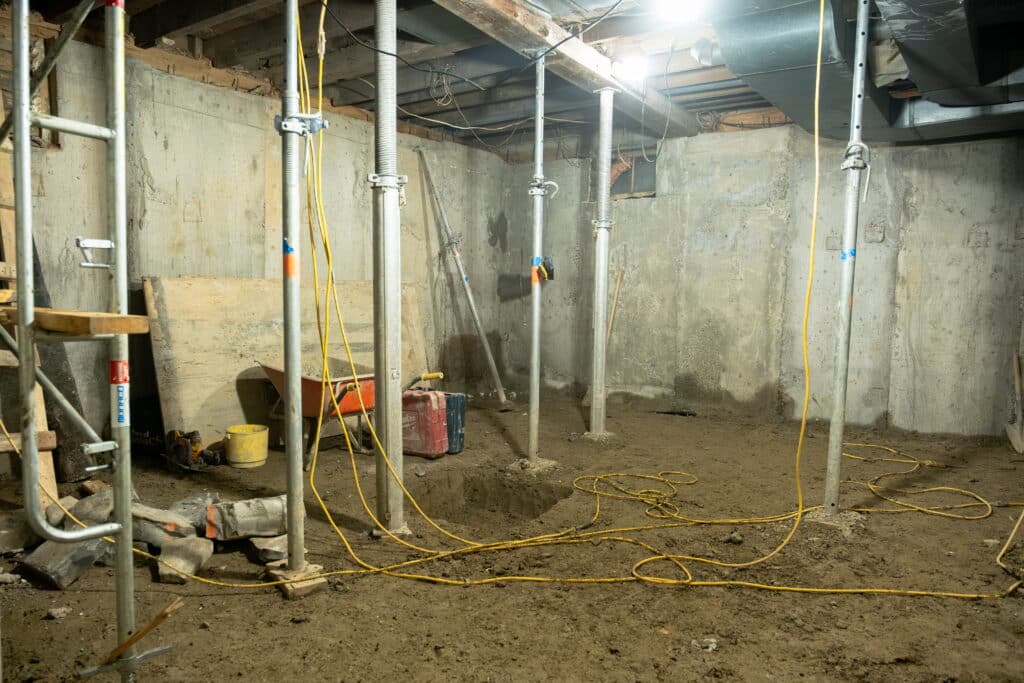
We all know how expensive real estate is in Canada. No wonder more people are choosing to renovate their homes rather than buy a new condo or house. It’s really challenging to add a floor on the roof, so sometimes a basement underpinning is your best option. Here’s a realistic overview of what you’ll pay in 2026:
| Service | WillFix Price | Toronto Market Range |
| Basement Underpinning (up to 4 ft down) | $50–$100/sq. ft | $70–$150/sq. ft |
| Dig Out Crawl Space | $50–$100/sq. ft | $60–$120/sq. ft |
| Enlarge Crawl Space | $90–$220/sq. ft | $90–$200/sq. ft |
| Convert Crawl Space to Full Basement | $90–$220/sq. ft | $90–$220/sq. ft |
| Bench Footings (alternative method) | Project-based | $75–$150/linear ft |
These are per-square-foot rates for the core underpinning work. Total project costs, including permits, engineering, concrete, and plumbing, are detailed in the breakdown below.
Basement Underpinning Cost Calculator
Get an instant estimate for your project. Enter your basement size and options below — the calculator uses current Toronto underpinning rates.
"*" indicates required fields
Total Underpinning Cost by Basement Size
The size of your basement is the single biggest driver of your final invoice. Here’s what full underpinning projects typically cost across common footprints in Toronto:
| Basement Size | Estimated Total Project Cost |
| Under 500 sq. ft. | $40,000–$70,000 |
| 500–800 sq. ft. | $55,000–$85,000 |
| 800–1,200 sq. ft. | $75,000–$100,000 |
| 1,200+ sq. ft. | $100,000+ |
Keep in mind that these figures cover excavation, new concrete footings, structural engineering, permits, and a new concrete floor. They do not include interior finishing (drywall, flooring, electrical) or optional add-ons like waterproofing or utility relocation, which are priced separately. You can learn more about this topic in our blog post covering how much it costs to finish a basement in Canada.
Full Basement Underpinning Project Cost Breakdown
Basement underpinning is a complex project, a collection of components, each with its own cost. So, if you want to go from start to finish, here’s what a complete project looks like:
| Component | Typical Cost in Toronto (2026) |
| Excavation and concrete footings | $15,000–$50,000 |
| Structural engineering drawings | $1,500–$7,000 |
| Building permit (city + engineering bundle) | $2,000–$3,000 |
| New concrete floor | $3,000–$8,000 |
| Plumbing and weeping tile | $3,000–$8,000 |
| Basement waterproofing | $3,000–$10,000 |
| Utility relocation (per system) | $9,000+ |
| Interior finishing (optional) | $10,000–$30,000 |
Please note that engineering drawings and a building permit are not optional in Toronto: every basement underpinning project requires both before work begins. Waterproofing is technically separate, but since the walls are already exposed during underpinning, most homeowners add it at this stage to avoid reopening the job later.
What Factors Affect the Basement Underpinning Cost?
Two identical-looking houses often produce very different underpinning quotes. And here’s why.
Basement size
More square footage means more digging, more concrete, and more labour. A 400 sq. ft. basement is a fundamentally different project than a 1,000 sq. ft. one, even if you’re digging the same depth.
Excavation depth
Standard basement underpinning in Toronto brings the floor down 2–4 feet. Anything beyond 4 feet adds meaningful complexity — you’re looking at deeper shoring requirements, additional engineering sign-offs, and more concrete volume. Expect each additional foot past 4 to add roughly 15–30% to your base cost.
Underpinning method
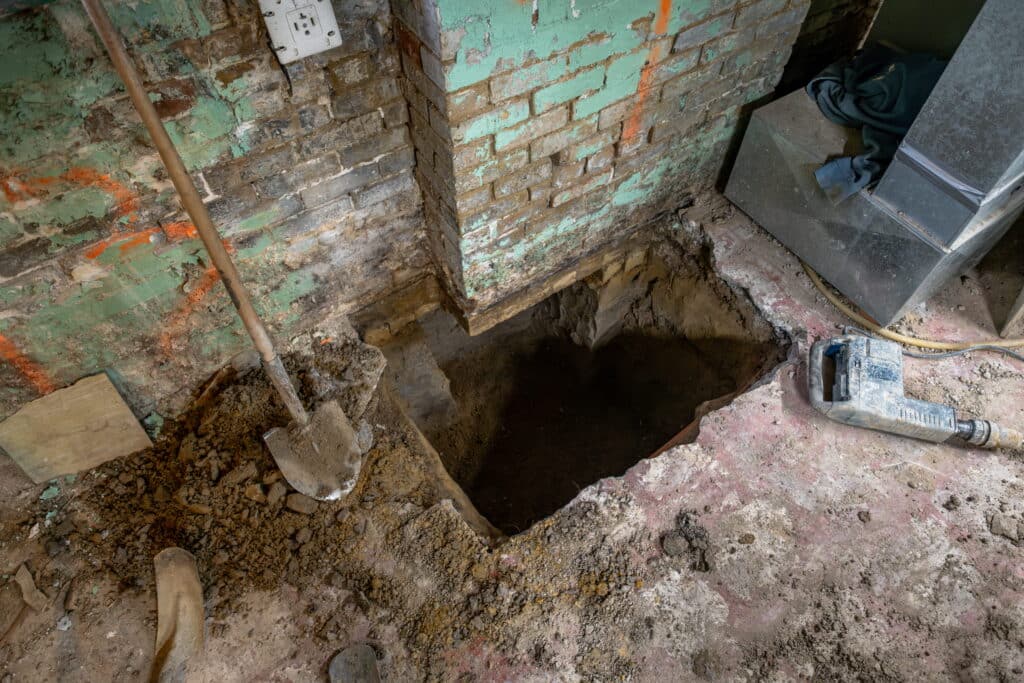
Mass concrete underpinning is the traditional approach: excavate beneath existing footings in alternating sections, pour new concrete, let it cure, repeat. It preserves every square inch of your floor plan.
Bench footings are faster and typically 30–40% cheaper. Instead of digging beneath the existing footing, a concrete “bench” is built up against the inside of the foundation wall. The trade-off is real: that bench eats 12–18 inches of floor space along every wall. For a smaller basement, this can make an already tight room feel cramped once it’s finished.
Soil & ground conditions
Toronto’s soil profile changes significantly by neighbourhood. Clay-heavy areas, common in older parts of North York, Etobicoke, and the east end, require extra precautions during excavation and can slow the job considerably. High water tables and unexpected rock formations have the same effect. Poor soil conditions typically add 10–25% to the base estimate.
Foundation type & condition
Poured concrete foundations in decent shape are the most straightforward to underpin. Rubble stone and brick foundations, found in many pre-war Toronto homes, need more careful handling and sometimes repair before basement underpinning can begin. If your foundation is deteriorating, expect both a longer timeline and a higher price.
Site accessibility
A contractor with full access to equipment can move quickly. A narrow lot, a tight side yard, or a dense urban block may require manual excavation for part or all of the project. Manual digging is slower and more expensive (and sometimes significantly so). If your home is a semi-detached or rowhouse in the downtown core, this is worth asking about upfront.
Utility relocation
Plumbing drains, HVAC ducts, and electrical panels that sit below the new floor level need to be moved before excavation gets underway. Each system costs $9,000 or more to relocate. Many homeowners are surprised by this item — it doesn’t always come up in early conversations, but it’s common enough that you should ask your contractor about it before signing anything.
Mass Concrete Underpinning vs. Bench Footings
Mass concrete underpinning and bench footings are two completely different methods of basement underpinning, so it’s obvious that their costs are different too. Here is an approximate cost estimate for each method:
| Aspect | Mass Concrete Underpinning | Bench Footings |
| Cost | $50–$150/sq. ft | $75–$150/linear ft |
| Usable floor area | Full | Reduced (bench takes 12–18″ per wall) |
| Structural complexity | Higher | Lower |
| Project duration | Longer | Shorter |
| Best suited for | Larger basements, rental suites, finished rooms | Smaller basements, tighter budgets |
| Permit required | Yes | Yes |
There’s no universally right answer here. For a basement you’re converting into a legal suite or finished living space, mass concrete underpinning almost always makes more sense — you want every square foot. For a utility room or a project where budget is the priority, bench footings are a legitimate option.
Permits and Engineering: What Toronto Requires
The City of Toronto requires a building permit for all underpinning work. The official permit fee is $11.89 per linear metre of wall being underpinned, with a minimum charge of $214.79. In practice, most homeowners pay $400–$900 directly to the city, depending on their perimeter footage.
The higher cost is the structural engineering package — stamped drawings, calculations, and sign-off from a licensed engineer. This typically runs $1,500–$7,000, which is why contractors usually quote permits and engineering together as a combined $2,000–$3,000 line item.
One thing to plan for: permit approval from the City of Toronto currently takes 6–12 weeks. Factor that into your timeline. Construction itself takes 4–8 weeks once the permit is in hand, meaning most projects run 3–5 months from contract to completion.
As of February 2026, the city also requires an updated permit application form. Your contractor should handle this, but it’s worth confirming. With WillFix, you won’t have to worry about all that paperwork because we handle drafting and obtaining building permits ourselves, saving you extra stress.
Crawl Space Work: Costs and Options
Not every Toronto home has a poured-concrete basement. Many properties sit on crawl spaces. In these cases, WillFix often offers clients crawl space excavation services. Here’s what those projects cost:
| Service | WillFix Price |
| Dig Out Crawl Space | $50–$100/sq. ft |
| Enlarge Crawl Space | $90–$220/sq. ft |
| Convert Crawl Space to Full Basement | $90–$220/sq. ft |
Converting a crawl space to a full basement is one of the more involved projects on our roster. It requires full excavation, new footings, a complete drainage system, and waterproofing — but the end result is an entirely new floor of livable space. For homeowners who need more room and can’t build up or out, it’s often the only option available.
Is Basement Underpinning Worth It in Toronto?
For most homeowners, yes, the numbers work. Adding a legal basement suite typically generates $1,500–$2,500 per month in rental income in Toronto, which means the project pays for itself over time. Even without a rental suite, underpinning increases usable square footage and adds meaningful value at resale.
That said, underpinning doesn’t make sense in every situation. If your goal is a storage or a utility room, there are cheaper ways to get there. If your foundation has serious structural issues, those need to be addressed first — sometimes at a cost that changes the overall math. The best way to find out if it’s worth it for your specific home is to have someone like WillFix, a basement underpinning contractor, walk through the space and give you an honest assessment.
Conclusion
Having an idea of the basement underpinning and lowering cost is half of the success of project planning. It’s an investment not just in terms of money but also in enhancing your house’s value and functionality. With a plan and a professional at your side, you can make this ambitious project a reality well within your budget.
Expert opinion
Leroy S. Gage
Leroy is a professional with 25 years of practical experience in foundation construction and engineering. His deep knowledge and understanding of regional building regulations and environmental conditions allow him to offer the most modern and customized solutions.
It may be challenging to decide whether you need such a long and time-consuming home upgrade right away. That’s why I recommend you take your time and think. Prepare a budget plan; probably ask your neighbours – maybe they already did basement underpinning and can recommend someone. Or just contact WillFix professionals and get a free and extensive consultation
Basement Underpinning Cost FAQ
-
What is basement underpinning?
Basement underpinning, sometimes referred to as foundation underpinning, is a construction technique used to increase the depth of a building’s existing foundation or to strengthen it. It involves excavating beneath the existing foundation and installing additional support to improve structural stability. You start this process when a building’s foundation shows cracks or begins to shift due to soil movement, aging, or reduced load-bearing capacity.
-
How long does basement underpinning take in Toronto?
Construction typically takes 4–8 weeks once work begins. The bigger delay is usually the permit process — the City of Toronto currently takes 6–12 weeks to approve underpinning applications. Budget 3–5 months total from when you hire a contractor to when the space is ready to finish.
-
Do I need to move out while underpinning is happening?
Most homeowners don't. Underpinning is done in staged sections, so the structure stays supported throughout — your house is never left without a foundation. That said, there will be noise, vibration, and construction dust for several weeks. Your contractor should walk you through what to expect based on the specific scope of your project.
-
What's the difference between underpinning and basement waterproofing?
These are separate services that address different problems. Underpinning lowers your foundation to increase ceiling height. Waterproofing stops moisture from getting through your foundation walls. Many homeowners do both at the same time — since the walls are already exposed during underpinning, it's a logical moment to waterproof — but they're independent scopes of work priced separately.
-
Can I turn my underpinned basement into a legal rental suite?
Yes, but it requires a separate permit application. Toronto's requirements for a legal basement apartment include a minimum ceiling height of 1.95 m (approximately 6'5"), an egress window, interconnected smoke and CO alarms, a separate entrance, and compliance with Ontario Building Code fire separation requirements. A contractor with experience in legal suite conversions can help you design the project to meet those standards from the start.
-
How do I know if my home is a good candidate for underpinning?
The main variables are your existing foundation type and condition, your soil conditions, how much depth you need to achieve your goals, and site accessibility for equipment. A reputable contractor will assess all of these during a site visit. Most homes in Toronto are candidates for underpinning — but the cost and complexity vary enough that a project assessment is the only way to get a realistic picture of what you're looking at.
